BioRevolution #10 - Organoids
Before diving into more discussions on organoids, I realized that it’s crucial to first address the concept of organoids itself. Recently, while talking about Organoid Intelligence, a member of the audience asked, “What exactly is an organoid?” This question illuminated the need to clarify this concept for everyone, not just those within the scientific community. As someone deeply motivated to make science accessible beyond the realm of scientists, it felt strange to have overlooked such a fundamental point.
My BSc. graduation thesis was almost entirely related to this topic, and I began with a similar introduction… In a world where everything has become so personalized, where social media platforms use advanced personalization, it was inevitable that healthcare would also move away from a one-size-fits-all approach. In an environment where personal outcomes are expected, the processes themselves must also be tailored to the individual. So, when we think of personalized treatment and its associated processes, what comes to mind? Naturally, the answer is organoids, the very subject of our discussion. By creating organoids from a patient’s own cell sources, a unique, patient-specific treatment process is designed. This truly represents a revolutionary shift in the field of healthcare.
Today, we’re delving into the topic of organoids. This won’t be our first or last conversation about organoids, so I encourage you to read carefully and take in this fascinating subject.
Scientific Perspective
An organoid is essentially a laboratory-grown, three-dimensional, miniaturized version of an organ. These structures are derived from stem cells or differentiated cells and possess the ability to self-organize and renew themselves. Organoids contain multiple cell types found in an organ and mimic some of the key features of real organs, such as their cell composition and basic functions. Typically, they arise through the spontaneous self-organization of their constituent cells, although in certain cases, specific hormonal or growth factor signals are introduced to direct the differentiation of very immature stem cells. […] Organoids serve as simplified, tissue-engineered in vitro models that can replicate the complex structure and function of tissues. They are developed in three dimensions, meaning they have a more realistic structure compared to traditional flat cell cultures.
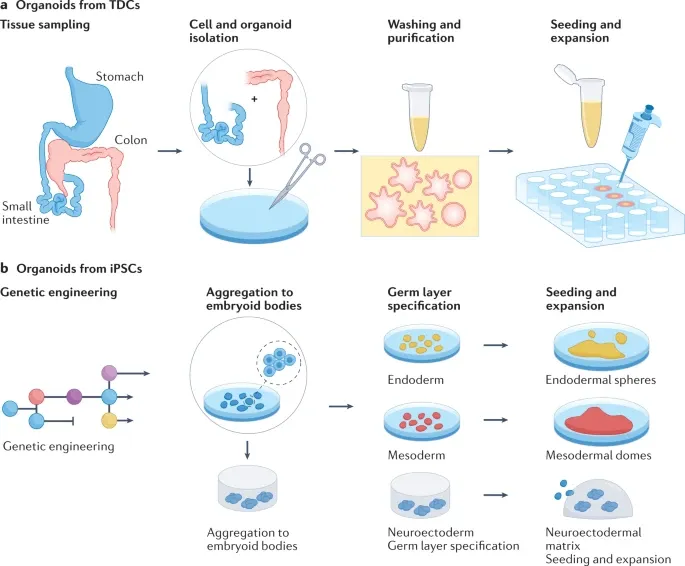
Creating an organoid involves a fascinating process that starts with sourcing the right cells, which can be stem cells like embryonic stem cells (ESCs), induced pluripotent stem cells (iPSCs), or even somatic stem cells. These cells are remarkable because they have the potential to become various types of specialized cells found in our organs. To initiate organoid formation, scientists first obtain these cells through a process of mechanical or enzymatic dissociation, where tissues from organs or previously preserved organoids are carefully broken down into smaller fragments or individual cells. […]
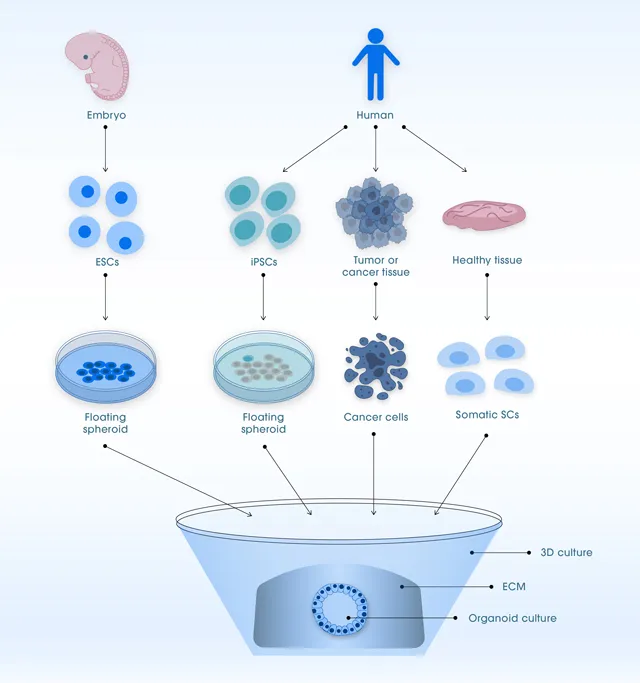
Once the cells are isolated, they are placed in a special culture medium that encourages them to group together, forming small 3D clusters known as spheroids. These spheroids are the building blocks of organoids and can be created using different methods, including suspension cultures, bioreactors, or even roller bottles. After spheroid formation, they are transferred into a gel-like substance, such as extracellular matrix (ECM) or matrigel, which provides a supportive environment that mimics the natural surroundings of cells in the body. The choice of medium and the specific growth factors added to it are tailored to the type of organoid being created, whether it’s for the stomach, liver, or even a tumor model. Over time, with careful nurturing, these spheroids develop into fully grown organoids that closely resemble their in vivo counterparts, offering a powerful tool for research into human biology and disease. This entire process can take several weeks to months. […]
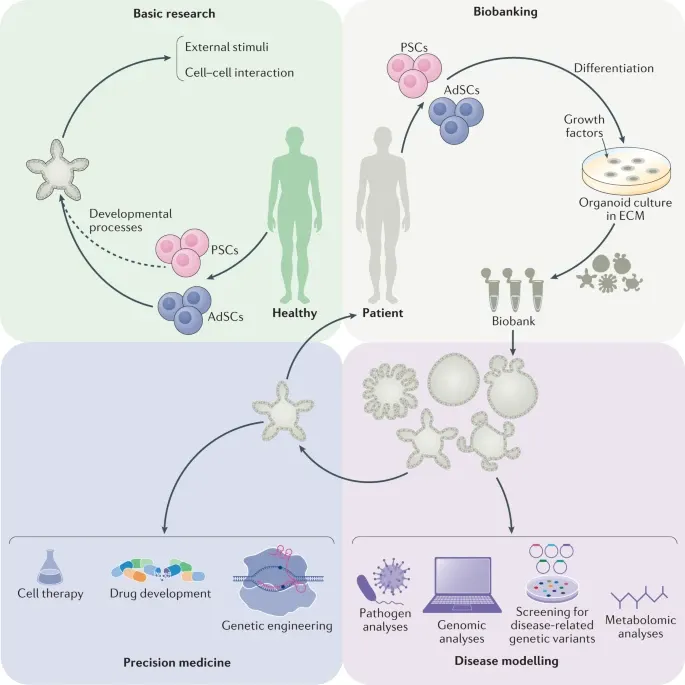
Organoids are powerful tools used in scientific research to better understand human biology and disease. They serve as miniature models of real organs, allowing researchers to study how organs develop, function, and respond to various treatments in a controlled laboratory environment. Because organoids can mimic the complexity of human tissues, they are especially valuable for studying diseases, testing new drugs, and even exploring personalized medicine approaches, where treatments can be tailored to the specific needs of individual patients. Additionally, organoids offer a promising alternative to animal testing, providing more accurate human-relevant data while reducing the need for animal models in research.
🪄Video Suggestion
Organoids Animation by XVIVO | Scientific Animation
Market Perspective
The global human organoids market was valued at USD 1.18 billion in 2025. It is projected to grow from USD 1.44 billion in 2026 to USD 5.71 billion by 2034, a CAGR of 18.8%. The main drivers are advances in stem cell research, which make it possible to grow complex organoids more reliably, and growing investment from pharmaceutical and biotech companies, which use organoids to improve R&D productivity and reduce costly late-stage failures.
-Fortune Business Insights, Human Organoids Market Report 2026-2034-
Startup Ecosystem
Organoid startups are growing especially in the US (Boston and the San Francisco Bay Area) and in Europe. Here are some examples:
A Luxembourg based startup, founded in 2019 as a spin-off from the Luxembourg Centre for Systems Biomedicine at the University of Luxembourg, is accelerating the development of treatments for Parkinson’s disease. It turns stem cells from individual patients into 3D midbrain organoids and assembloids. These contain the dopamine-producing neurons that are lost in Parkinson’s, so they replicate each patient’s disease pathology more accurately than traditional models. It uses these models for deep phenotyping and phenotype-based drug screening, combined with AI-assisted analysis. Its goal is to find treatments that protect neurons, instead of only relieving symptoms. The company has collaborated with industry partners on drug discovery and on studying alpha-synuclein, the protein that clumps in the brains of Parkinson’s patients.
A Cambridge, Massachusetts based startup, founded in 2021 by two scientists who created the world’s first scalable human immune organoid, builds an “immune system in a dish.” Its platform combines lymph-node organoids with AI and robotics to replicate the human immune system at scale, across diverse populations. This allows drugs to be tested on human immune responses from the start, instead of relying on mice. Eight pharmaceutical partners, including three Fortune 500 companies, are testing more than 50 drugs and immunotherapies on its platform. In one study, its immune organoids were “vaccinated” with a universal flu vaccine candidate and produced B cells that reacted to many different flu strains, including strains not included in the vaccine. It raised a $21 million Series A in 2025, led by AIX Ventures, bringing its total funding to nearly $30 million.
A San Francisco Bay Area based startup, founded in 2020, focuses on rare genetic diseases in children. It grows fetal-like organoids that carry the same gene mutations as the patients, then screens drugs against them. Because these organoids model early human development, they can reveal new drug targets for pediatric diseases. The technology was validated at Stanford and has already led to the discovery of a drug target in a pediatric heart disease that could not have been found with traditional models. It is backed by Y Combinator, and in 2023, it received a $274,829 grant from the US National Science Foundation. In January 2026, it signed a partnership to combine its AI-driven organoid platform with a stem cell services company for drug safety testing in rare diseases.
A Zurich based company, founded around 2009 as a spin-off from ETH Zurich, has grown from a startup into one of the global leaders in 3D human tissue models for drug safety and efficacy testing. It builds scalable, spheroid-based microtissues: tiny balls of human cells that behave much more like real organs than flat cell layers, so drug toxicity and efficacy can be tested earlier and more reliably. Instead of staying small, it has started to consolidate the field. In late 2025, it acquired a Lausanne based organoid startup together with the organoid culture technology of an EPFL spin-off, and in May 2026, it acquired a California based imaging and phenotypic assay company to expand in the US. Its earlier funding round was led by Zeiss Ventures.
Organoid research is not only moving forward in startups. A leading Boston based cancer research institute runs a center dedicated to patient-derived models, which creates, characterizes, stores and distributes cancer models grown from patients’ own cells, including organoids. Using these models, researchers can test therapies almost in real time to predict how a patient will respond, which could transform cancer care. The center has built a large collection of models of brain tumors, blood cancers and many other solid tumors, and makes them available to academic and industrial researchers worldwide. The institute also has a dedicated organoid center within its radiation oncology department.
If you are interested in organoids and would like to learn more about the startups mentioned here, or discover other promising teams in this space, feel free to reach out to me. I’d be happy to share more details and help you find the right connections.
The information in this Market section was last updated in September 2026. Market figures, funding amounts and company details may have changed after this date.
🚨Groundbreaking News
FDA Modernization Act 2.0: transitioning beyond animal models with human cells, organoids, and AI/ML-based approaches
The FDA Modernization Act 2.0 represents a significant shift in drug development by removing the mandatory requirement for animal testing, opening the door for alternative methods such as organoid technology. Historically, animal models have been the cornerstone of drug testing, but they come with high costs, ethical concerns, and issues with translating results to human trials.
As the industry moves towards patient-derived organoids, these models offer a more accurate and scalable alternative for drug screening, preserving the genetic makeup of the original tissue and allowing for better prediction of drug efficacy and toxicity. The growing adoption of organoids, particularly in areas like immuno-oncology and inflammatory diseases, signals the dawn of a new era in patient-centric drug development, making the FDA’s recent legislative changes a pivotal moment in modern medicine.
Future Perspective
I will present to you two scenarios, two imaginative journeys into the future perspective.
- Let’s fast forward to a time when organoids are readily available and imagine how your experience as a patient might unfold.
You walk into the doctor’s office and describe your symptoms—symptoms that you’ve never experienced before. The doctor reviews your digital twin, a virtual model of your body that tracks your health in real-time. However, this particular symptom originates from a part of your body that isn’t monitored by a biosensor, and there’s no record of past issues in this area. Imaging techniques are employed, and a tumor is detected. Your doctor updates your digital twin with this new information, and the process of gathering a sample begins.
A biopsy is taken from the tumor, and organoid research is initiated. Scientists create a miniaturized version of your tumor—an organoid—that mimics its behavior. Through this organoid, disease modeling is conducted, and the resulting data is integrated into your digital twin. This allows your digital twin to reflect the progression of the disease accurately. Multiple treatment scenarios are then tested, and the five most promising drugs are identified. Next, these drugs are tested on the organoid, and the most effective one is selected for your treatment. Meanwhile, a biosensor tailored to your condition is installed, enabling comprehensive, real-time monitoring of the disease.
As you discuss these developments with your doctor, your digital twin offers insights into potential future illnesses, providing preventive healthcare recommendations. The biggest question lingering in your mind, however, is, “How could this disease have been prevented?”
Even in a world equipped with advanced technology that makes us feel secure, people of that time will be pondering new challenges. “How was this not prevented?” We are always on the frontier of the most advanced systems, yet we still find ourselves questioning and striving for something more.
- Imagine a future where the concept of organoids has advanced to the point where we can create entire organs from scratch. Now, let’s delve into a thought experiment: If we were to construct all the organs of a person using organoids, would that be considered cloning?
You step into the lab, where scientists have successfully grown a complete set of human organs from organoids. The organs are perfectly functional, each one crafted to replicate the exact characteristics of a real human body. But here’s the intriguing question: If we assembled these organs into a full body, would this creation be a clone?
The next step in this scenario is even more mind-bending—could this body, made entirely from organoids, actually be brought to life? The notion of animating a body grown from organoids leads to a cascade of questions about identity and existence. Would this being, this organoid “clone,” begin its existence with the knowledge and experiences that you possess, or would it start from a blank slate, learning and growing just like any other human being?
Now, consider your feelings towards this creation. Would you feel a sense of envy toward this being, made to mirror your physical form, yet unburdened by your past? The idea of an organoid clone living a life parallel to yours, with the potential to carve out its own unique path, raises profound questions about self-identity and the nature of life itself.
As we ponder these possibilities, it’s clear that even in a world of incredible technological advancements, we would continue to wrestle with the implications of what it means to create life, to replicate our own existence, and to confront the emotions that arise from such groundbreaking developments. Would you embrace this new form of life, or would you find yourself questioning its place in the world—and your own?
📰 SUBSCRIBE TO MY LINKEDIN NEWSLETTER
If you liked this newsletter article, I hope you’ll consider being a regular subscriber. 🙏
Just scroll up to the very top and click that SUBSCRIBE button.
Originally published on LinkedIn.