BioRevolution #8 - Decentralized Science (DeSci)
When we say science, we mostly think of science centers, institutes, and universities. What if we were to talk about a decentralized science? I would like to think that this thought causes the same excitement in you as it does in me.
Before diving deeper into the concept of decentralization, I would like to touch upon the beauty of science and bio-things. As a molecular biology and genetics student, I was involved in many communities during my university years, and later, I made this my profession and worked both as a community manager and in a community management consultancy company. Bio-things are so beautiful that they can even be mentioned together with a subject that we think of as far away as community management. One of the cornerstones of the DeSci theme, which you will now see, is the community. In addition, I was previously part of the team that wrote a sectoral deepening report on DAOs. This leap, which I made at the time not by thinking about DeSci but by following my curiosity, has benefited me greatly while writing this issue.
So, if you’re ready, let’s dive into the depths of the decentralized world of science together!
Scientific Perspective
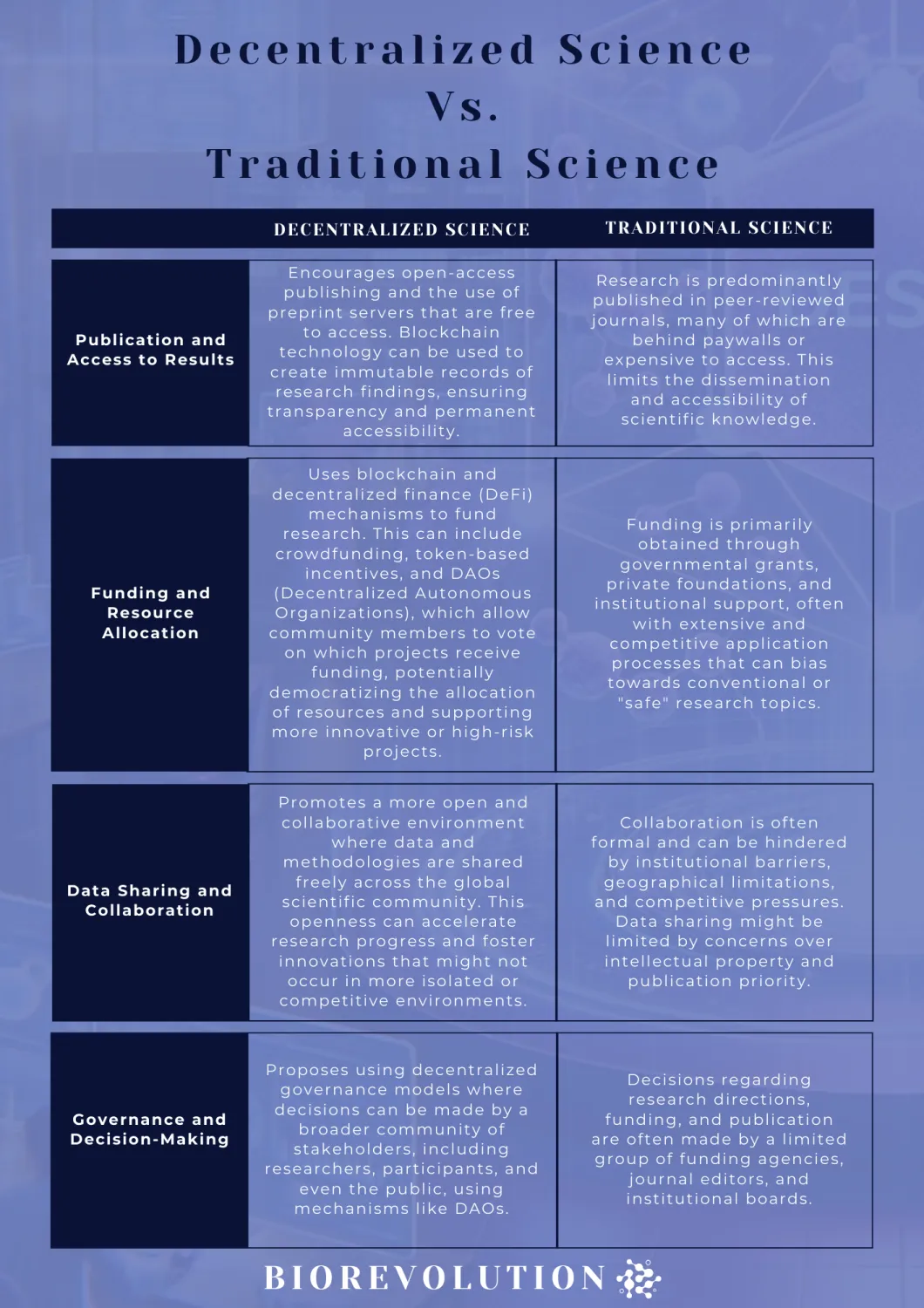
The scientific foundations of DeSci are set to revolutionize how research is conducted, shared, and validated. By integrating blockchain technology into the core of scientific activities, DeSci not only promises to enhance the reliability and accessibility of scientific outputs but also to create a more collaborative and inclusive global research environment. This shift could potentially democratize the process of scientific discovery, making it less reliant on traditional funding and publishing models and more responsive to the broader scientific community’s needs.
Blockchain’s Role in Scientific Integrity: Immutability, Transparency and Accessibility
DeSci utilizes blockchain technology to create immutable records of research findings and methodologies, significantly enhancing transparency across the scientific process. This technological approach not only secures a verifiable truth regarding research developments but also makes scientific knowledge more accessible to the public. By circumventing traditional paywalls that restrict access to scientific papers, DeSci facilitates more inclusive access to information, allowing anyone interested to engage with and build upon existing knowledge without financial barriers. Also, Blockchain technology offers an immutable ledger, which is pivotal in the scientific realm for documenting research findings, methodologies, and data analyses without the risk of tampering or loss.
Facilitating Data Sharing and Collaboration
DeSci greatly simplifies the sharing of scientific data among researchers across the globe. Through decentralized networks, researchers can share data and resources without the barriers often imposed by institutional policies or geographic limitations. This can accelerate the pace of scientific discovery, as researchers can build directly on each other’s work in real time, fostering unprecedented levels of collaborative innovation.
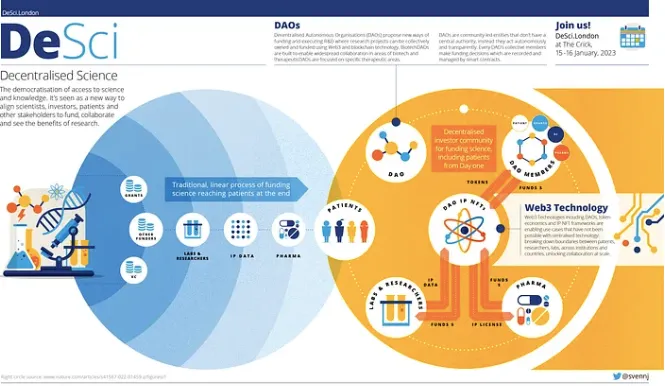
Left: Traditional linear process of funding science, reaching patients at the end; Right: Decentralised investor community for funding science, including patients from Day One.
Innovative Funding Models
A key advantage of DeSci is its ability to transform how scientific projects are funded. Traditional funding models often rely on grants from governmental agencies or private foundations, which can be highly competitive and restrictive. DeSci introduces decentralized funding via DAOs (Decentralized Autonomous Organizations), where community members—ranging from fellow scientists to the general public—can directly fund research projects they believe in. This method not only democratizes the funding process but also potentially speeds up the allocation of resources to promising research that conventional funding bodies might otherwise overlook.
Intellectual Property and Incentivization
Smart contracts on blockchain platforms provide a novel way of managing intellectual property rights in science. Researchers can use these contracts to automatically enforce agreements related to data usage, collaboration, and profit-sharing. Furthermore, DeSci can implement token-based incentive systems that reward contributions to the scientific community, from data collection to peer reviewing, aligning individual motivations with the collective goal of advancing knowledge.
Enhancing Peer Review
DeSci proposes radical changes to the peer review process by introducing transparency and community involvement. Instead of the traditional anonymous review, DeSci environments utilize blockchain to enable open peer reviews that are visible and verifiable by the entire community. This openness can reduce biases and conflicts of interest, leading to more objective and rapid assessments of scientific work.
🪄Video Suggestion
What’s Decentralized Science? [ DeSci Explained ] - by CoinMarketCap
Market Perspective
The market capitalization of Decentralized Science (DeSci) currently stands at $411 million. This value represents the total worth of all DeSci tokens in circulation, and it is roughly half of the $806 million the sector reached in May 2024. Like the rest of the crypto world, DeSci moves in cycles, and today it is in a quieter phase.
-CoinGecko, Decentralized Science (DeSci) category, September 2026-
The picture is very different on the clinical side. The global decentralized clinical trials (DCTs) market was valued at $8.8 billion in 2024 and is projected to reach $18.8 billion by 2030, growing at a CAGR of 13.7%.
-BCC Research, Decentralized Clinical Trials: Global Markets, 2026-
Startup Ecosystem
DeSci projects are global by nature, since they are built as online communities rather than companies with a single headquarters. Most of them grew around one shared infrastructure, and many are now connected through the same funding network. Here are some examples:
A Berlin based company builds the legal and technical infrastructure that DeSci runs on. Its key invention is the IP-NFT: a research agreement between funders and a lab is recorded on the blockchain as a unique token, so the rights to future intellectual property can be owned, governed and even split into smaller “IP tokens” by a community. This tackles a big problem in biotech, where much early-stage research is abandoned before reaching clinical trials because it can’t find funding. It also runs an accelerator for biotech DAOs, and in 2024 its users contributed more than 600 ETH to fund research projects.
A protocol launched by the same founding team has become the biggest name in DeSci. It works like a Y Combinator for biotech DAOs: token holders vote on which new research communities join the network, get access to their fundraises and provide liquidity for their tokens. During its launch event it raised $45 million in ETH and BioDAO tokens, and it secured strategic funding from Binance Labs. Its token went live in January 2025 through a Binance Launchpool. It is now the second-largest DeSci token by market cap.
A longevity-focused community is the largest decentralized organization for longevity science. Members vote on and fund research projects that aim to extend human lifespan and healthspan, and the resulting intellectual property is held by the community. For example, it has funded work on RNA-based longevity therapies and co-funded a project to improve the accuracy of protein synthesis in Alzheimer’s disease. In January 2023, it raised $4.1 million from investors including Pfizer Ventures, Balaji Srinivasan and Bryan Johnson.
A San Francisco based startup, founded in 2019, is building an open platform where scientists publish, discuss and review research outside traditional paywalled journals. It rewards researchers with its own token for sharing work and for tasks like peer review and answering scientific questions, and the amount they earn depends on how valuable the community finds their contribution. This tackles a long-standing problem in academia, where peer review is unpaid and much research remains behind paywalls. The startup raised a $5 million seed round in 2023 led by Open Source Software Capital, with participation from Boost VC and Y Combinator’s Garry Tan. In 2025 its token was listed on a major US crypto exchange, and it is now the third-largest DeSci token by market cap.
A women’s health community funds research in areas that traditional funding has long overlooked, such as reproductive health and menopause. Its members vote on which projects to fund, and it has been one of the original DAOs in the biotech DAO accelerator mentioned above.
If you would like to get to know these communities and the teams behind them, or discover other promising projects in decentralized science, feel free to reach out to me. I’d be happy to share more details and help you find the right connections.
The information in this Market section was last updated in September 2026. Market figures, funding amounts and company details may have changed after this date.
🪄Blog Suggestion
What is Decentralized Science (DeSci)? by Sasha Shilina
Decentralized science (DeSci) by Ethereum
Future Perspective
- Funding is very important in scientific research. We should not think of this as just developing projects; it is also critical in training scientists. If the funding problem in the academy can be overcome, more young minds will be eager to work in laboratories and be trained as scientists. This means more projects in the long term and faster development of science.
- I’m not saying that working collaboratively is not possible under traditional conditions, just that it has great challenges that we all know. We can expect these to be overcome, the far distances to become closer, and the universality of science to strengthen.
- If you read BioRevolution #2 - Biotechnology Trends in 2034 issue, you can reach many of my other future expectations on this subject.
📰 SUBSCRIBE TO MY LINKEDIN NEWSLETTER
If you liked this newsletter article, I hope you’ll consider being a regular subscriber. 🙏
Just scroll up to the very top and click that SUBSCRIBE button.
We will be together again in two weeks with our new topic. If you guess the next topic, write it in the comments.
See you beyond DeSci :)
Originally published on LinkedIn.