BioRevolution #5 - DNA Data Storage
We are so productive organisms. 500 million tweets are sent on Twitter daily. 294 billion emails are exchanged each day. But that’s not all! By 2025, it’s estimated that a whopping 463 exabytes of data will be created globally every day. (To put this in perspective, that’s equivalent to 212,765,957 DVDs produced daily.)
That’s cool but when we take a step back and look, where do we store all this data? What does it mean for our Earth and its capacity?
You can think about that. See the problem, and build the future… Time to look at the future because we are on BioRevolution Newsletter!
We will examine DNA data storage from 3 main perspectives;
- Scientific Perspective
- Market Perspective
- Future Perspective
Let’s start with a scientific perspective!
Scientific Perspective
As we navigate through the era of big data, the environmental footprint of conventional data storage methods is becoming increasingly problematic. Data centers, the powerhouses behind our data storage and processing needs, are notorious for their hefty energy consumption. As our global data generation escalates, the demand for storage space and computational power surges, exacerbating energy usage and environmental strain.
In response to this growing concern, researchers are turning to a more organic solution: DNA, nature’s own storage device. Renowned for its capacity to compactly store vast amounts of genetic information, DNA presents an innovative alternative to traditional data storage methods. Professor Mark Bathe from MIT highlights the extraordinary potential of DNA, suggesting that a mere coffee mug’s worth could theoretically hold the entirety of global data. This shift towards DNA-based data storage not only promises to significantly reduce the environmental impact but also revolutionizes our approach to managing the digital deluge. […]
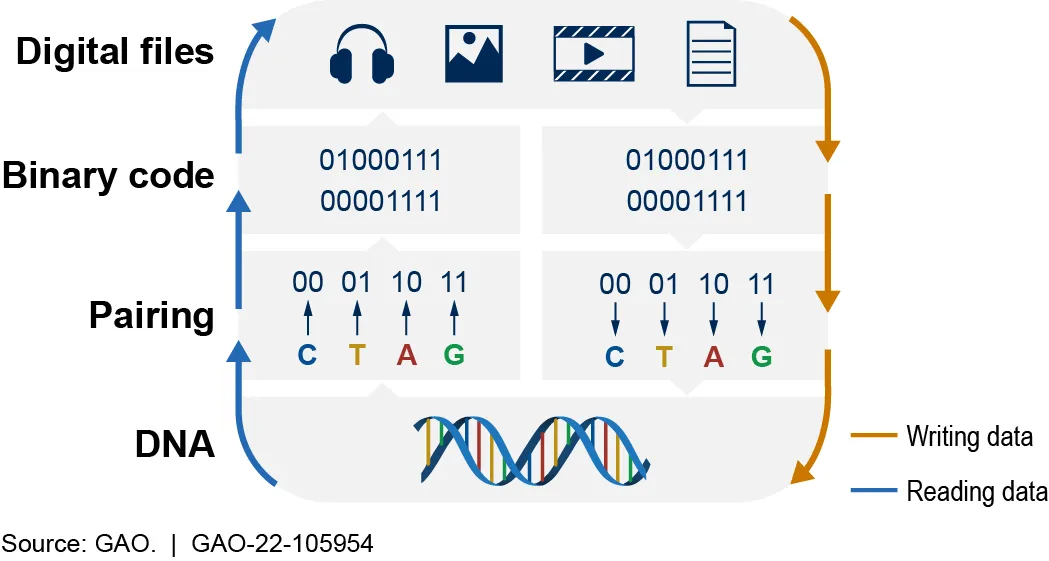
Traditional digital storage systems represent all kinds of data, including text and images, through a binary code of 0s and 1s. Similarly, DNA can encode this information using its four constituent nucleotides: A, T, G, and C.
A method is needed to turn all of these zeros and ones into As, Ts, Cs, and Gs, and one of the easiest ways to do that is to take pairs. Let’s say;
00 = C
01 = T
10 = A
11 = G
So the information can be taken we have and it would be compressed by half because we can go for two characters down to one character.
Before continuing our topic, we need to know what is a Gigabyte, Terabyte, or Petabyte to understand this topic clearly.
kB: kilobyte (1000 bytes)
MB: megabyte (1,000,000 bytes)
GB: gigabyte (1,000,000,000 bytes)
TB: terabyte (1,000,000,000,000 bytes)
PB: petabyte (1,000,000,000,000,000 bytes)
EB: exabyte (1,000,000,000,000,000,000 bytes)
ZB: zettabyte (1,000,000,000,000,000,000,000 bytes) […]
The method used can store an impressive 215 petabytes of data in just one gram of DNA. For clarity, 250 petabytes equates to around 1.5 billion Facebook photos - a huge volume of data. Yet, the potential doesn’t stop there. The estimated maximum capacity for DNA data storage is a zettabyte within a gram of DNA, equivalent to 1 trillion gigabytes.
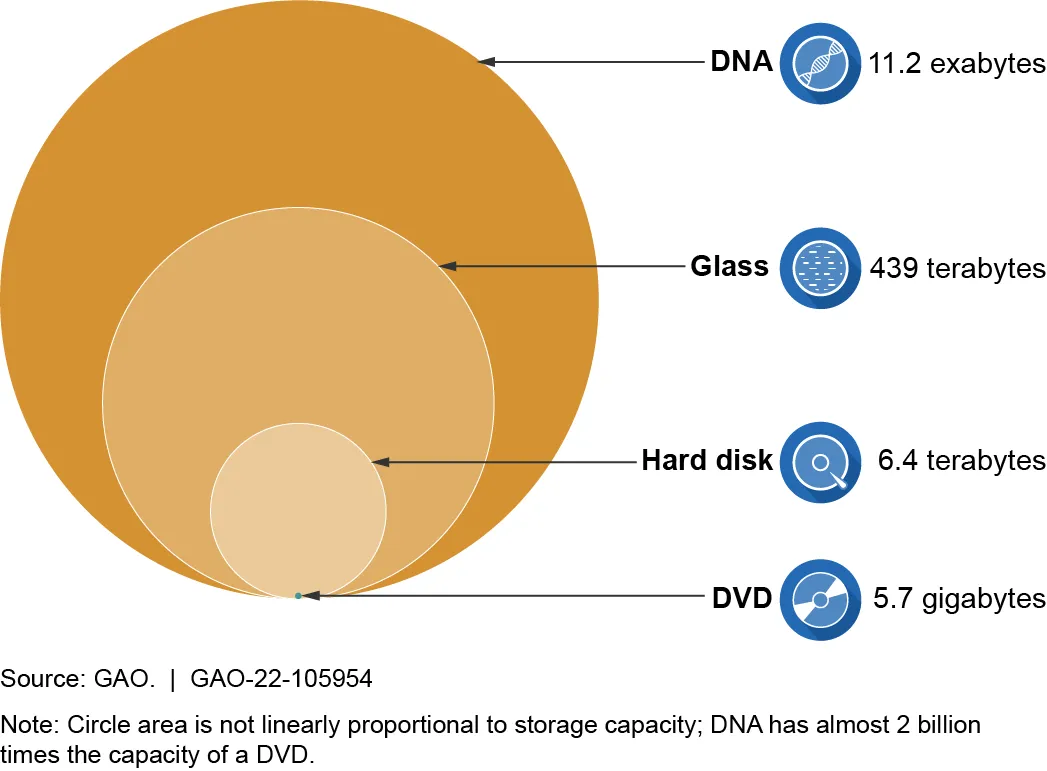
Here are 7 pivotal points that underline the progress and potential of this innovative storage solution:
- Unprecedented Storage Density: One gram of DNA can store up to 215 petabytes of data. This means that a mere gram of DNA can hold approximately 220,160 terabytes, illustrating the massive potential for data storage in a minimal physical space. […]
- Innovative Encoding Methods: Data encoding in DNA utilizes various methods to efficiently use DNA sequences while minimizing errors. These methods include translating text into nucleotide sequences and converting arbitrary data into a ternary system to fit DNA’s biological structure, ensuring data integrity and accessibility.
- Competing with Tape Drives: To rival current archival storage solutions like tape drives, DNA storage technologies aim to reach write speeds of about 2 gigabits per second. Achieving this would mark a monumental step toward making DNA storage a viable commercial option. […]
- Biological Integration Possibilities: The potential of in vivo data storage in living organisms opens new frontiers. Through synthetic biology and CRISPR gene editing, organisms can be engineered to store data within their genetic material, with experiments showing that a single mouse could theoretically store about 2 terabytes of information. […]
- Long-Term Stability: DNA is an incredibly stable medium, capable of preserving information for thousands of years under the right conditions. This contrasts sharply with traditional storage media, which may degrade significantly over much shorter periods.
- Biosecurity and Data Safety: Storing data in DNA could offer new levels of security and privacy, as accessing and reading DNA data requires specific technological know-how and equipment, adding a layer of protection against unauthorized access.
- Environmental Impact: DNA data storage has the potential to reduce the environmental footprint associated with massive data centers. By compacting vast amounts of data into a small biological space, it reduces the need for large physical infrastructures and the associated energy consumption.
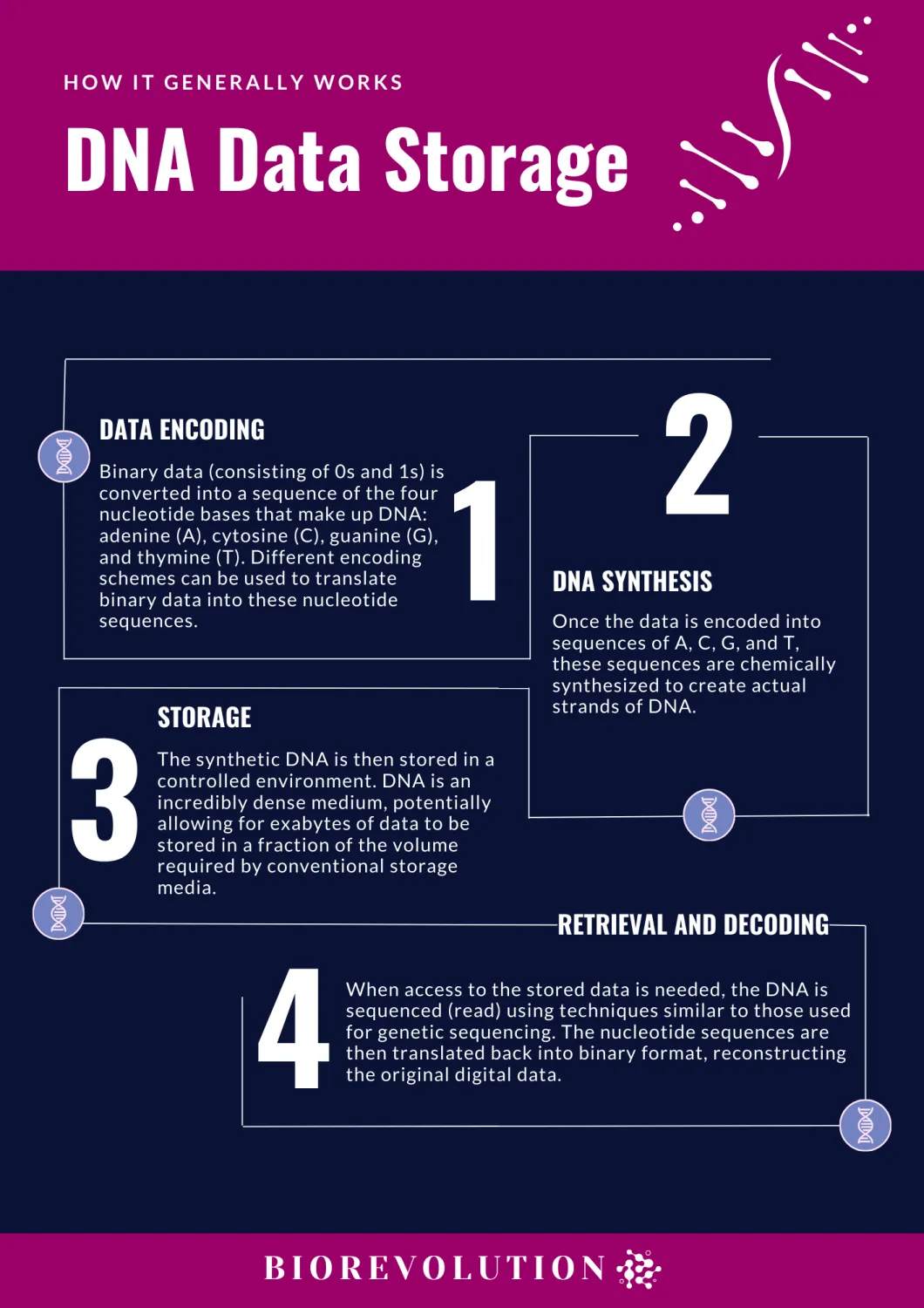
According to industry expert Steffen Hellmold from Twist Bioscience , DNA data storage is particularly suitable for storing vast amounts of information such as video surveillance data and extensive datasets required for artificial intelligence training. The nature of DNA storage, which can be maintained in either a liquid or dehydrated state, inherently involves a latency period, typically spanning a few hours before the data can be accessed once requested. This characteristic positions DNA storage as an ideal solution for long-term archival needs rather than for immediate access requirements. […] (for now…)
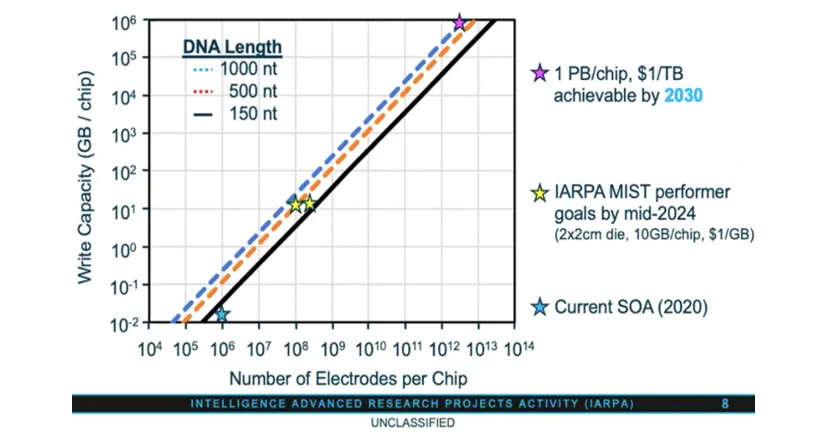
🚨News: Though the field of DNA data storage is nascent, the fundamental cost trends of manufactured DNA synthesis and sequencing for data storage continue to fall. For synthesis, the IARPA MIST project sets a goal of $1000/terabyte by 2024 and $1/terabyte by 2030. […]
Market Perspective
The DNA data storage market was valued at USD 145.8 million in 2025. It is expected to grow from USD 272.8 million in 2026 to USD 6.3 billion in 2031 and USD 80.2 billion in 2035, a CAGR of 88%. North America is the largest market, and Asia-Pacific is the fastest-growing region. The main driver is the rising demand for high-density storage, as companies, research institutions and governments look for ultra-compact media that can hold petabytes of data in very little physical space.
-Global Market Insights, DNA Data Storage Market Report 2026-2035 (Report ID: GMI7884)-
Startup Ecosystem
DNA data storage startups are growing especially in France, the US (the San Francisco Bay Area and Boston) and Ireland. The field is also moving from research towards its first commercial products and data center deployments. Here are some examples:
A Paris based startup, founded in 2021 from research at Sorbonne University and the French CNRS labs, stores digital data in synthetic DNA. It builds DNA using enzymes, assembling pre-made DNA blocks instead of writing each letter one by one with chemistry. Its credit card-sized DNA card costs $1,000, holds up to one kilobyte of data and can last up to 150 years. It raised an $18 million Series A in December 2024. In March 2026 it acquired the assets of a Boston based DNA storage and computing pioneer, which gave it key patents, hardware and a new office in Boston. The company plans to launch its first commercial solutions in data centers in the second half of 2026.
A South San Francisco based startup was spun out in May 2025 from a publicly listed synthetic DNA company, with $155 million in seed funding. Its investors include ARCH Venture Partners, Deerfield Management, Bezos Expeditions and In-Q-Tel. In September 2026 it announced a chip with 5.6 billion electrochemical DNA synthesis sites, 700 times more than previous DNA synthesis chips. The chip is built in layers: its silicon base is made by TSMC, and the wet layer where the chemistry happens is added at imec in Belgium. The platform can also compute on the stored data. Short DNA “query strands” are mixed with the stored DNA, bind to matching sequences and displace them, so millions of possible answers are tested at the same time in the same drop of liquid. Its first early access customers have already received DNA cartridges designed with the exact shape of a standard LTO tape case, so they can fit into existing archive systems.
An Ireland based startup, founded in 2016 in Cork, takes a different approach. Instead of building large archives, it makes a programmable DNA storage material that can be applied as a coating or mixed into other materials. This way, data files or small applications can be encoded directly into a physical object, and no cloud or central network is needed to read the data back. The company grew out of the IndieBio EU accelerator in Cork, with backing from SOSV and Enterprise Ireland.
If you are interested in DNA data storage and would like to learn more about the startups mentioned here, or discover other promising teams in this space, feel free to reach out to me. I’d be happy to share more details and help you find the right connections.
The information in this Market section was last updated in September 2026. Market figures, funding amounts and company details may have changed after this date.
🪄Video Suggestion: Where to store big data? In DNA: Nick Goldman at TEDxPrague
Publication date is 25.05.2013
Future Perspective
- The unique nature of DNA data storage presents novel opportunities for enhancing data security and privacy. The complexity of DNA data retrieval could integrate with emerging technologies like blockchain, leading to new paradigms in data safety and biosecurity. This could result in highly secure storage methods that prevent unauthorized access, ensuring data integrity and confidentiality in an era where digital security is paramount.
- The evolution of DNA data storage will likely foster increased collaboration among diverse scientific disciplines, including genetics, bioinformatics, chemistry, and computer science. This integrated approach is vital for addressing the multifaceted challenges associated with DNA data storage, such as improving read/write speeds and error rates. By leveraging the strengths and insights from these varied fields, researchers can accelerate the progress toward practical and efficient DNA-based storage systems.-You can read my subtitle “The Coopetitive Revolution Transforming Biotech in 2034” in BioRevolution #2 - Biotechnology Trends in 2034
- While it was thought that most of the technologies we use today could not enter our homes, they are now entering our pockets. We will see a similar scenario here. I think there is no need to mention that the price will decrease and usage will become easier.
📰 SUBSCRIBE TO MY LINKEDIN NEWSLETTER
If you liked this newsletter article, I hope you’ll consider being a regular subscriber. 🙏
Just scroll up to the very top and click that SUBSCRIBE button.
We will be together again in two weeks with our new topic. If you guess the next topic, write it in the comments.
See you beyond DNA Data Storages :)
Originally published on LinkedIn.