BioRevolution #21 - Generative Biology
If machines can learn to read the language of biology with increasing accuracy, can they also begin to write in it?
Many drug discovery pathways begin with proteins.
Inside every cell, proteins fold into highly specific three-dimensional structures. Many of these structures sit on the surface of the cell membrane, acting as sensors, gates, or communication points between the cell and its environment. Modern drugs often work by binding to these proteins. When a molecule attaches successfully, it can trigger a chain of chemical reactions that change how a cell behaves.
For decades, one of the central challenges of biology has been understanding how proteins reach these shapes in the first place. A small structural change can completely alter how a protein functions. This made protein folding one of the most difficult problems in computational biology and pharmaceutical research.
In the previous issue, we explored the DNA Language Model (DLM). But an important question follows naturally from that discussion. If machines can learn to read the language of biology with increasing accuracy, can they also begin to write in it?
This question sits at the center of Generative Biology.
Generative Biology focuses on designing biological systems that do not already exist in nature. Researchers are now developing models capable of generating entirely new protein structures, predicting molecular interactions, and designing drug candidates before they are physically synthesized in a laboratory. Instead of relying only on trial and error experiments, biology is gradually becoming a field where simulation, prediction, and generation operate together.
This transition did not emerge suddenly. Several technological layers matured simultaneously to make it possible.
The cost of sequencing a human genome has fallen dramatically over the past two decades. The first human genome project, completed in 2003, cost approximately $3 billion. Following the arrival of next generation sequencing technologies in 2007, costs rapidly declined from millions of dollars to thousands. By the late 2010s, the industry crossed the symbolic $1,000 threshold. In 2022, the Sanger Institute announced that a human genome could be sequenced for roughly $500. (…)
At the same time, artificial intelligence systems became significantly more capable of identifying patterns inside large biological datasets. In 2024, AI researchers Geoffrey Hinton and John Hopfield received the Nobel Prize in Physics for foundational contributions to machine learning. In the same year, Demis Hassabis and John Jumper received the Nobel Prize in Chemistry for AlphaFold2, a system capable of predicting the structures of nearly all known proteins.
These developments are beginning to reshape how biology itself is approached.
At the same time, skepticism toward these developments remains essential.
Generative Biology introduces powerful capabilities, but power alone does not guarantee reliability. The strongest contributions to this field may ultimately come from researchers who approach it cautiously. Scientific skepticism forces systems to be tested repeatedly, weaknesses to be identified early, and hidden risks to become visible before large-scale adoption occurs. Without that pressure, biological systems generated by increasingly capable AI models could be deployed with a level of confidence that exceeds our actual understanding.
As biology becomes more programmable, the central challenge may no longer be whether we can generate new biological systems.
The challenge may become understanding the consequences of what we choose to generate.
Scientific Perspective
Generative Biology represents a shift in how biological research is conducted.
Traditionally, biology has focused on observation and prediction. Researchers studied existing organisms, existing proteins, and existing molecular interactions in order to understand how living systems function. Artificial intelligence first entered biology through this same pathway. Early biological AI systems primarily analyzed data. They identified patterns inside DNA sequences, predicted protein structures, classified diseases, or estimated how molecules might behave.
Generative Biology moves one step further. Instead of only predicting biological structures that already exist, these systems attempt to create entirely new biological designs. The objective is no longer limited to understanding life. The objective increasingly becomes engineering new biological components with specific functions. This distinction is important.
In the previous issue, we explored DNA language models, systems trained to read the language of biology. These models learn patterns inside genetic sequences in a way similar to how large language models learn patterns in human text. A DNA language model may predict whether a mutation is harmful, identify relationships between genes, or classify biological sequences according to their function.
Generative Biology uses many of the same computational foundations, but with a different objective. Instead of interpreting biological language, the system generates new biological sequences designed to achieve a desired outcome.
The difference resembles the distinction between reading and writing. A person who understands grammar and vocabulary can analyze a book. A person who fully masters the language can also write a new one.
Biological AI is gradually moving from interpretation toward generation. Proteins sit at the center of this transition.
DNA contains biological instructions, but proteins perform most of the functional work inside living systems. They transport molecules, regulate chemical reactions, transmit signals between cells, repair damage, and defend the body against disease. The structure of a protein determines how it behaves. Even a small change in its three dimensional shape can alter its biological function entirely. This makes protein design one of the most important problems in biotechnology.
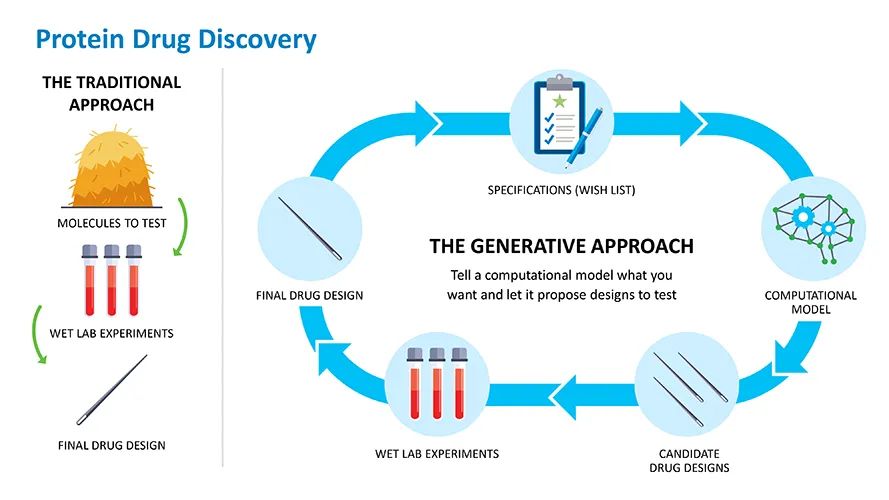
Much like finding a needle in a haystack, researchers have traditionally used high throughput screening systems in the lab to find proteins that have the potential to become drugs. Generative computer models can allow scientists to design needles, or specific proteins, that can be tested in the lab without even needing haystacks. The more data that goes into the models, the better the output design becomes and the fewer needles the models will need to generate. (https://www.amgen.com/stories/2022/06/generative-biology–designing-biologics-with-greater-speed-and-success)
For decades, drug discovery largely depended on searching through nature. Researchers screened enormous libraries of molecules, hoping to find one capable of interacting effectively with a biological target. The process often resembled searching for a needle in a haystack. Scientists might examine thousands or millions of candidate molecules before identifying one that showed promising results. Even then, the molecule usually required years of optimization before becoming a viable drug candidate.
The difficulty becomes even greater because the biological design space is almost unimaginably large. A protein is built from chains of amino acids. Even relatively small proteins can produce more possible sequence combinations than there are atoms in the observable universe. Testing these possibilities experimentally is impossible. No laboratory system could physically evaluate such an enormous search space.
Artificial intelligence changes this dynamic by narrowing the search. Instead of randomly screening molecules, generative systems attempt to predict which structures are most likely to achieve a desired biological function before physical testing begins. Researchers can define a target behavior, such as binding to a disease-related protein, and the model generates candidate structures optimized for that purpose. This represents a transition from biological discovery toward biological design.
One useful way to understand this process is through the familiar lock and key analogy often used in pharmacology.
Many diseases involve proteins that behave abnormally inside the body. Drug molecules function by binding to these proteins in highly specific ways, similar to how a key fits into a lock. Traditional drug discovery searches for existing keys that happen to fit the lock sufficiently well. Generative Biology attempts to design the key directly.
Researchers first analyze the structure of the biological target. AI systems then generate molecular shapes predicted to bind precisely to that target. Instead of screening massive collections of naturally occurring compounds, the system computationally engineers new candidates before they are synthesized in the laboratory. This approach becomes especially important for what researchers call “undruggable” targets.
A large percentage of disease associated proteins have historically been considered difficult or impossible to target with conventional drugs. Some proteins lack suitable binding pockets. Others change shape too dynamically for small molecules to interact effectively. Traditional pharmaceutical chemistry often struggles to address these targets.
Generative models may provide alternative solutions by designing entirely new protein structures capable of interacting with these difficult biological surfaces in ways conventional compounds cannot. Several types of AI architectures are currently driving this field.
One important approach uses diffusion models.
Diffusion systems became widely known through image generation tools. These models begin with random noise and gradually refine that noise into coherent images. In Generative Biology, researchers apply a similar concept to proteins. Instead of generating pixels, the model generates molecular structures.
A diffusion model may begin with a random arrangement of amino acids or structural fragments. Through repeated computational refinement, the system gradually shapes the structure into a stable protein predicted to perform a specific task. Systems such as RFdiffusion, developed in David Baker’s laboratory, use this approach to design entirely new proteins that do not exist in nature. The process resembles molecular sculpting performed computationally.
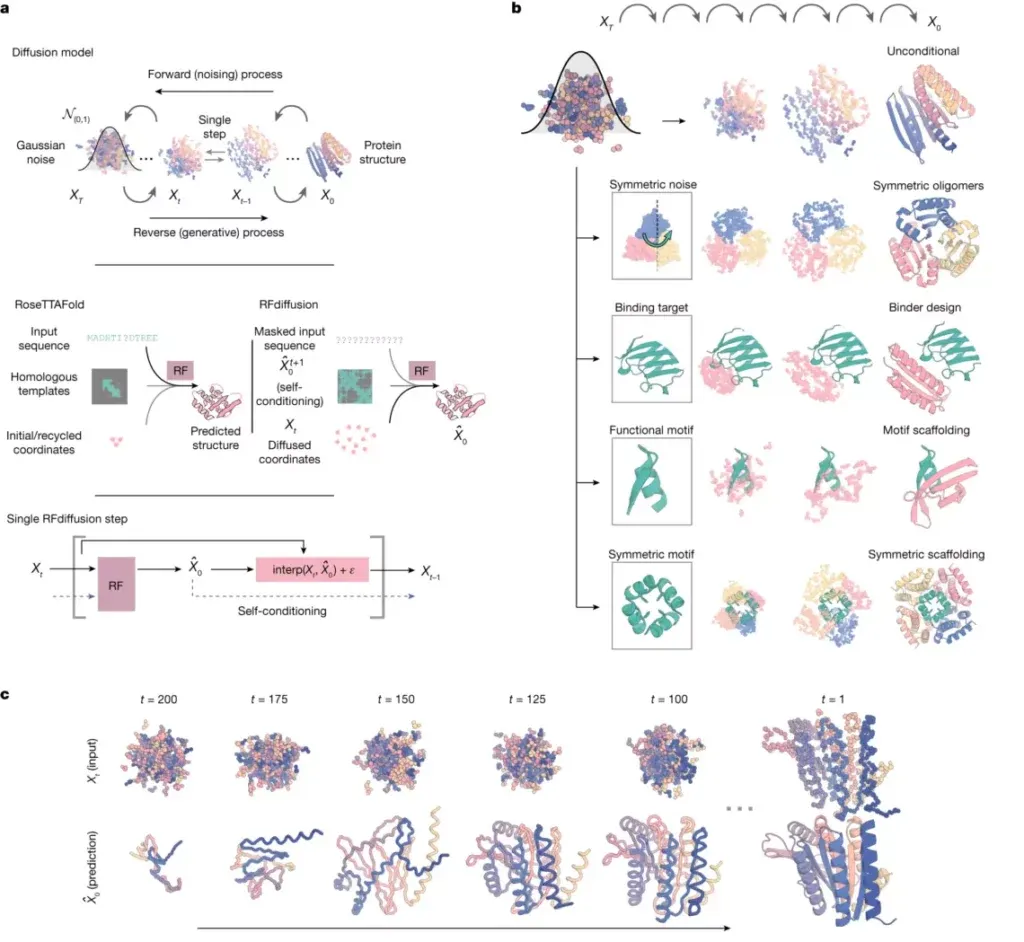
Protein design using RFdiffusion (https://www.nature.com/articles/s41586-023-06415-8)
Another major approach uses biological language models.
These systems are trained on massive databases containing protein sequences collected from living organisms. Over time, the model learns the statistical patterns governing how proteins are constructed, much like text-based language models learn grammar and sentence structure.
Once trained, the model can generate new protein sequences with desired properties. Researchers may ask the system to generate proteins likely to bind a particular receptor, stabilize a molecular pathway, or exhibit certain chemical characteristics.
In practice, these systems operate through an iterative feedback loop between computational and experimental biology.
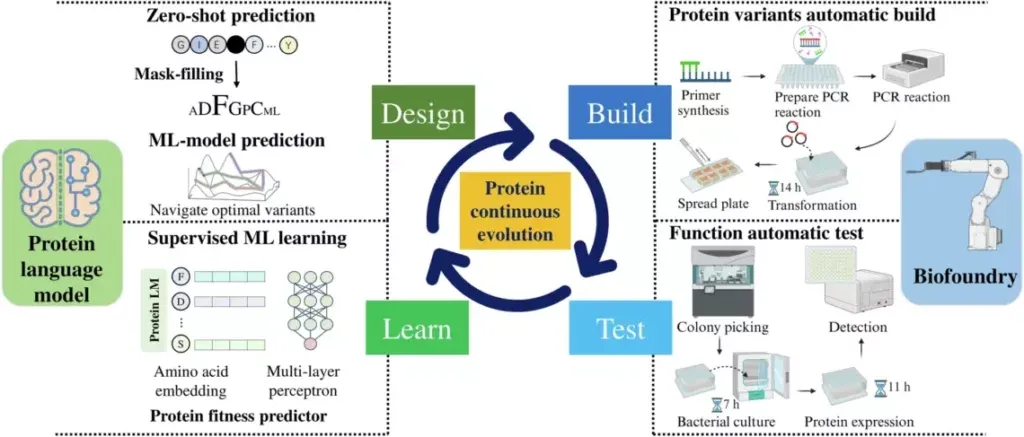
Overview of protein language model-enabled automatic protein evolution. (https://www.nature.com/articles/s41467-025-56751-8)
The computational “dry lab” generates candidate molecules digitally. Researchers then synthesize and test the most promising candidates in the experimental “wet lab.” The experimental results are subsequently fed back into the model, improving future predictions and generations.
As more biological data enters the system, the models gradually become faster, more accurate, and more capable of generating functional proteins.
This iterative loop is already changing parts of pharmaceutical development. In some antibody discovery programs, generative systems are reducing development timelines significantly while increasing the probability that engineered candidates succeed during experimental validation.
The implications extend beyond drug discovery alone. But, at the same time, the field remains constrained by biological complexity.
Living systems are not static engineering environments. Cells constantly adapt, compensate, and interact with surrounding systems in ways that remain only partially understood. A protein predicted to function perfectly inside a simulation may behave differently inside a living organism. Safety, long term stability, immune responses, and unintended biological interactions remain major challenges.
For this reason, Generative Biology should not be viewed as a replacement for experimental biology. Instead, it increasingly functions as a new layer added on top of it. Artificial intelligence narrows the search space. Biology still determines what ultimately works.
Market Perspective
The synthetic biology market was valued at approximately $20 billion in 2025 and is projected to exceed $70 billion within the next decade. Yet the more important signal is not the size of the market itself. The stronger signal is where institutional conviction and long-term capital are beginning to concentrate. (…)
Over the past two years, some of the largest funding rounds, pharmaceutical partnerships, and infrastructure investments in biotechnology have increasingly centered around generative biology platforms.
One of the clearest examples emerged in April 2024 with the launch of Xaira Therapeutics. The company debuted with approximately $1 billion in committed funding, making it one of the largest biotechnology launches in recent history. Xaira was co founded by David Baker , whose laboratory developed RFdiffusion and several other foundational systems for computational protein design. (…)
The company’s strategy reflects a broader transition occurring across the pharmaceutical industry. Instead of treating AI as a support tool for data analysis, firms are increasingly building entire discovery pipelines around generative systems themselves.
Xaira Therapeutics combines machine learning models, proprietary biological datasets, automated experimentation systems, and therapeutic development into a single platform. Researchers can define biological constraints or desired binding characteristics, and the system generates candidate molecular structures optimized for those conditions. In practical terms, the platform attempts to computationally engineer therapeutic proteins before they physically exist.
Generate:Biomedicines represents another major example.
Backed by Flagship Pioneering, the same venture firm behind Moderna , the company focuses on generating entirely new protein sequences for therapeutic purposes. Its models are trained on extensive biological datasets and attempt to identify generalizable principles governing how proteins behave. The system then generates new molecular candidates while continuously learning from experimental feedback. (…)
The market has responded aggressively. Generate:Biomedicines has reached a valuation near $2 billion and established partnerships with major pharmaceutical companies, including a multibillion dollar collaboration with Amgen . (…) More recently, the company also raised hundreds of millions of dollars while securing a large antibody focused partnership with Novartis. (…)
The broader funding environment reinforces the same pattern.
After the biotechnology financing slowdown that followed the 2021 funding peak, synthetic biology investment rebounded strongly in 2024. Venture investment climbed back above $12 billion globally, driven largely by companies operating at the intersection of artificial intelligence, computational biology, and automated experimentation. (…)
Large pharmaceutical firms are also accelerating their participation.
For decades, major pharmaceutical companies primarily competed through clinical development scale, manufacturing infrastructure, and commercial distribution. Generative biology introduces a new competitive layer centered around data, computational models, and integrated AI infrastructure.
This is already changing partnership structures across the industry.

Isomorphic Labs , the Google DeepMind spin off focused on AI driven drug discovery, raised $600 million in early 2025 to expand what it describes as “AI science factories.” The concept combines specialized biological AI systems with robotic laboratory infrastructure capable of running continuous automated experiments. Instead of separating computational prediction from laboratory validation, the objective is to connect them into a unified learning system operating continuously. (…)
Eli Lilly and Company moved quickly into this space through a partnership with Isomorphic Labs worth up to approximately $1.7 billion in milestone payments alongside upfront capital. The collaboration focuses heavily on difficult biological targets previously considered inaccessible through conventional drug discovery methods. (…)
This category of “undruggable” targets has become strategically important across the industry.
Many disease related proteins cannot be effectively targeted using traditional small molecule chemistry. Generative systems potentially expand the available design space by engineering entirely new molecular structures capable of interacting with these targets in unconventional ways.
The implications are substantial because many of the remaining high value disease areas sit precisely within these previously inaccessible biological mechanisms.
Novo Nordisk has adopted a similarly aggressive strategy
The company established a multibillion dollar collaboration with Valo Health to integrate AI across its drug discovery pipeline, particularly in cardiometabolic diseases beyond its GLP 1 portfolio. In 2026, Novo Nordisk also announced a strategic collaboration with OpenAI to apply generative systems across research, manufacturing, and operational workflows. (…)
This signals another important transition.
Generative biology is no longer being treated solely as a discovery tool. Companies are increasingly integrating AI across the entire pharmaceutical stack, from molecular generation to manufacturing optimization and patient delivery systems.
Other major partnerships further reinforce this direction.
Bayer committed approximately $1.5 billion to its alliance with Recursion Pharmaceuticals, whose platform combines highly automated laboratories with large scale biological data generation. Recursion’s systems continuously produce cellular imaging and molecular interaction data that feed directly back into AI models. Some of its programs have reportedly reduced early discovery timelines from several years to under two years. (…)
Novartis expanded its own collaboration with Isomorphic Labs after initial projects progressed successfully. Roche announced large scale investments in NVIDIA powered AI infrastructure intended to support company wide AI accelerated healthcare initiatives. (…) Schrödinger, which combines machine learning with physics based molecular simulations, already has AI assisted drug candidates progressing through advanced clinical trials.
If you are interested in generative biology and would like to learn more about the startups mentioned here, or simply exchange ideas about this field, feel free to reach out to me. I’d be happy to share more details and help you find the right connections.
The information in this Market section was last updated in June 2026. Market figures, funding amounts and company details may have changed after this date.
Future Perspective
Together, these developments point toward a larger structural shift occurring inside pharmaceutical research.
More than 170 AI discovered drug programs are now reportedly in clinical development globally, with a growing number expected to enter large scale trials over the next several years. For investors, the question increasingly shifts away from whether generative biology can produce viable therapeutic candidates.
The more important question becomes which companies control the platforms, datasets, computational infrastructure, and experimental feedback loops required to scale this process effectively.
This resembles earlier platform transitions observed in other industries.
In software, value concentrated around operating systems, cloud infrastructure, and foundational platforms. In generative biology, a similar concentration may emerge around biological foundation models, proprietary experimental datasets, automated laboratory systems, and integrated AI driven discovery pipelines.
At the same time, another parallel trend is emerging around democratization.
Systems such as Evo 2 are beginning to make advanced biological modeling more accessible outside major pharmaceutical companies. Evo 2 demonstrated strong performance when analyzing non coding genomic regions previously considered difficult to interpret, including variants associated with BRCA1 linked breast cancer risk. (…)
Patrick Hsu described this direction as creating an “app store for biology,” where researchers can access pretrained biological systems for gene editing, protein modeling, and molecular design.
If these tools become broadly accessible, the structure of biotechnology innovation itself may change.
Historically, advanced drug discovery required enormous physical infrastructure, specialized equipment, and years of laboratory work. Generative biology partially shifts the bottleneck toward computational access, data quality, and model capability. Smaller laboratories may eventually gain capabilities previously limited to major pharmaceutical organizations.
This possibility introduces both opportunity and risk.
Organizations such as UNESCO and the OECD have already emphasized the need for genomic governance frameworks as biological design tools become more widely distributed. The OECD estimates the global bioeconomy could eventually exceed $1 trillion annually by 2030.
As biology becomes increasingly programmable, generative systems may begin functioning less like individual biotechnology products and more like foundational infrastructure for the broader bioeconomy itself.
🤨 Wait… Did you miss the article on Brain-Computer Interfaces?
📰 SUBSCRIBE TO MY LINKEDIN NEWSLETTER
If you liked this newsletter article, just scroll up to the very top and click that SUBSCRIBE button.
🪄 My TEDx Talk on BioRevolution is Live!
(English subtitles are available)
Originally published on LinkedIn.