BioRevolution #19 - Brain-Computer Interfaces
Today, we open the door to a direct connection with computers.
As I write these lines, my brain is moving faster than my hands. Ideas form quickly. Emotions follow them. I try to organize everything into sentences for this blog, yet my fingers struggle to keep up with the pace of my thoughts. At times, the excitement becomes overwhelming, and I need to pause for a moment during work.
That experience may not remain the same forever.
Many of the technologies we describe as “future technologies” are already under construction. Engineers and scientists are building them right now. For that reason, I always ask a simple question when writing about them: Why now?
Brain-computer interfaces offer a clear answer.
For decades, computers simply were not powerful enough to work effectively with the human brain. Neuroscience could observe signals, but translating those signals into meaningful digital information required computational power that did not yet exist. As computer scientists improved processing power, storage, and data analysis, life scientists gained new tools to explore the brain.
Research in brain-computer interfaces began in the 1970s. The challenge has always been formidable. Brain signals must be detected, analyzed, translated into computer-readable commands, interpreted correctly, and finally converted into a useful output. Each step introduces its own complexity. The brain itself is already one of the most intricate systems in nature.
Today, the landscape is changing. Advances in artificial intelligence and high-performance computing allow researchers to process neural data in ways that were previously impossible. With each improvement, the path toward practical brain-computer interfaces becomes a little clearer.
Welcome to the world of brain-computer interfaces!
BioRevolution #19 - Brain-Computer Interfaces issue is supported by Capital Cell, which is Europe’s leading investment platform specialized in biotech and health startups, connecting groundbreaking science with forward-thinking investors. This article is available in properly written 🇫🇷 French and 🇪🇸 Spanish on the Capital Cell blog.
Scientific Perspective
A brain computer interface, commonly abbreviated as BCI, is a computer-based system that acquires brain signals, analyzes them, and translates them into commands that control an external device. In simple terms, the system creates a direct communication pathway between the brain and a machine.
In our everyday actions, the brain normally sends instructions through the peripheral nerves to muscles. These signals allow us to speak, move our hands, or walk across a room. A BCI follows a different route. It bypasses the body’s usual pathways and uses brain signals themselves as the source of control. The commands generated from neural activity can operate a computer program, a robotic device, or a medical assistive system. (…)
This definition is quite strict. A true BCI must measure signals that originate from the central nervous system. Technologies that rely on muscle activity or voice recognition do not fall into this category. For example, a voice-activated assistant or a system that detects muscle movement is not considered a brain-computer interface. Even an electroencephalography recording system, often called EEG, does not qualify on its own. While EEG can capture brain signals, it only records them. A BCI must also interpret those signals and convert them into actions that affect the user’s environment.
There is also a common misconception about these systems. Brain-computer interfaces are often described as mind-reading technologies. In reality, they function in a very different way. A BCI does not extract thoughts from an unsuspecting person. Instead, it allows a user to intentionally generate brain signals that represent a specific goal. After a period of training, the system learns to recognize patterns in those signals and convert them into commands. In this process, the user and the interface operate together as a coordinated system. (…)
Types of BCI Systems
According to hardware placement
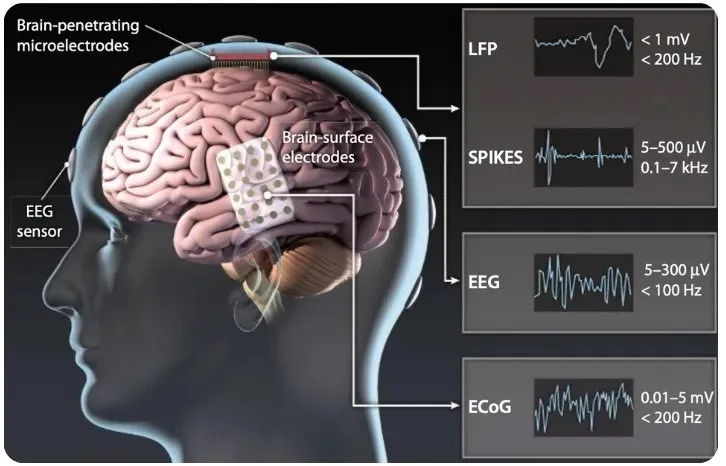
Brain computer interfaces are generally grouped according to how the brain signals are recorded.
Invasive systems place electrodes directly into the brain’s cortex. Because the sensors are located close to the neurons, the recorded signals have very high resolution. This precision makes invasive BCIs attractive for advanced medical applications, although the required surgery introduces significant risk.
Non-invasive systems record brain signals from outside the skull. The most common example uses EEG sensors placed on the scalp. These devices are far safer and easier to use, but the signals must pass through bone and tissue before reaching the sensors, which reduces their quality.
Semi invasive systems fall between these two approaches. In this case, electrodes are placed inside the skull but remain outside the brain tissue itself. This method often uses techniques such as electrocorticography to capture signals with better resolution than scalp recordings while avoiding direct penetration of the brain.
According to Function
Brain computer interfaces can also be classified according to how the brain signals are used within the system.
Passive BCIs monitor the user’s mental state without requiring intentional control. These systems observe signals related to attention, emotional state, fatigue, or cognitive workload. For example, a passive BCI could detect when a driver becomes distracted or tired.
Interactive BCIs analyze brain responses that occur while a person focuses on external stimuli. In these systems, neural activity is measured while the user responds to visual, auditory, or tactile signals. Common approaches include steady state evoked potentials and event related potentials such as the well known P300 signal.
Active BCIs rely on deliberate brain activity generated by the user. The person intentionally produces neural patterns that the system translates into commands. Motor imagery is a common example. A user may imagine moving a hand or rotating an object, and the system converts the resulting neural signals into actions performed by a device. (…)
Core Components of a BCI System
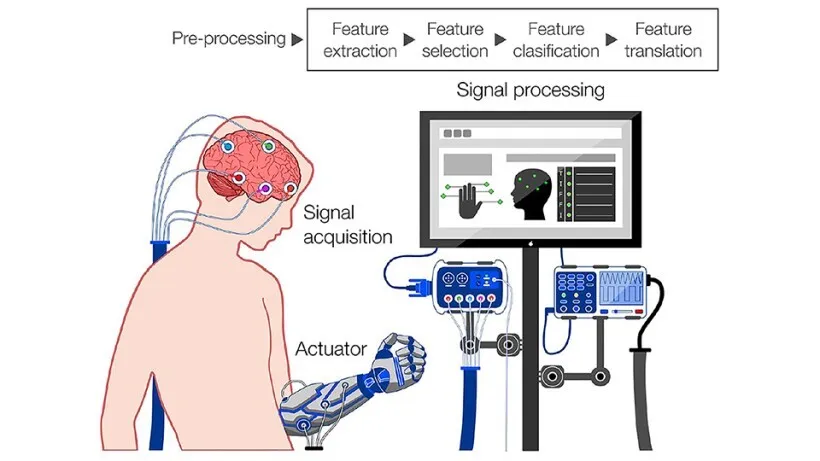
Despite the different hardware approaches, most brain computer interfaces follow the same sequence of operations.
The first stage is signal acquisition. Electrical activity generated by neurons is detected by recording electrodes. These electrodes may be located on the scalp, on the surface of the cortex, or within the brain depending on the type of BCI system. The captured signals are extremely small, so they must be amplified and converted into digital data that computers can process.
The second stage is feature extraction. At this point the system analyzes the recorded signals and identifies meaningful patterns. Neural signals are complex and often noisy, so the algorithm focuses on specific characteristics that represent the user’s intention.
Next comes feature translation. In this stage, machine learning models or signal processing algorithms convert the extracted patterns into commands that a device can understand. For example, a particular neural pattern might correspond to moving a cursor on a screen, selecting a letter in a spelling interface, or controlling a robotic arm.
The final stage is device output. The translated commands control an external device. This could be a spelling program that allows a person to type using brain activity, a motorized wheelchair, or a robotic prosthetic limb.
An important part of this process is feedback. The user receives information about how the device responds to their brain signals. Over time, this feedback allows the user to adjust their neural activity, improving the accuracy and stability of the system. In practice, the user and the interface gradually learn to work together more effectively.
Together, these components form the foundation of modern brain computer interfaces, turning patterns of neural activity into meaningful interaction with the outside world.
🪄Video Suggestion
- How Synchron ’s BCI Works -
Market Perspective
The global brain-computer interface (BCI) market was valued at USD 241 million in 2025. It is projected to grow from USD 296 million in 2026 to USD 961 million by 2034, a CAGR of 15.9%. China is becoming one of the most active players in the field: BCI has been named a “future industry” in China’s 15th Five-Year Plan (2026-2030), signaling state-level investment.
-Fortune Business Insights, Brain Computer Interface Market Report 2026-2034-
Startup Ecosystem
BCI startups are growing especially in the US, Spain and China. Here are some examples:
A New York based startup, founded in 2021, develops minimally invasive brain-computer interfaces for people with severe paralysis. Its thin-film implant has 1,024 electrodes embedded in a flexible film that conforms to the brain surface, and it is one-fifth the thickness of a human hair. Because it sits on top of the brain without penetrating tissue, it aims to be safer, removable and more scalable than traditional implants. AI software decodes the brain’s electrical signals in real time, so users can control computers and smartphones with their thoughts. In April 2025 it received FDA 510(k) clearance for use of up to 30 days, the first full regulatory clearance for a company developing a next-generation wireless BCI. It has implanted the device in more than 90 patients across multiple health systems. It raised a USD 102 million Series C in December 2024, bringing its total to USD 155 million, and later received further investment from a venture fund focused on paralysis.
An Austin, Texas based startup, founded in 2015, develops high data-rate brain-computer interfaces to restore communication for people who have lost the ability to speak. Its implant records signals from more than 1,600 individual neurons and can transfer over 200 bits of information per second with minimal delay. In November 2025 it received FDA approval to begin its clinical study, the first approval of its kind for speech restoration with a fully implantable BCI, and the first participant was implanted in June 2026. It raised a USD 33 million Series A in 2023, together with an FDA Breakthrough Device Designation, and industry databases estimate its total funding at around USD 108 million.
A Barcelona based startup, founded in 2019, develops graphene-based brain-computer interface therapeutics. Graphene is a single layer of carbon atoms, which makes it possible to build ultra-thin, flexible electrodes that can both read brain signals and deliver precise stimulation. Combined with AI, the platform aims to deliver adaptive therapies for neurological disorders, starting with Parkinson’s disease. In September 2025 it signed a collaboration with Mayo Clinic and opened a US subsidiary with a Boston office as a hub for US clinical trials, while keeping its headquarters and R&D in Barcelona. It has raised USD 124 million to date.
A Shanghai based startup, founded in 2021, develops ultra-flexible electrodes as fine as one-hundredth of a human hair and the world’s smallest wireless brain implant. Its softer electrodes are designed to be less intrusive for brain tissue, and they are implanted by the company’s own surgical robot. In early 2026 it used this robot to implant a 256-channel wireless system, the first clinical trial of its kind in China, and its product was granted access to the national fast-track channel for innovative medical devices. In April 2026 it raised RMB 500 million (about USD 73 million) in a round led by Alibaba, with Tencent also participating, bringing its funding over the past year to more than RMB 1.1 billion (about USD 160 million). It aims to implant around 40 patients through multicenter trials in 2026.
If you are interested in brain-computer interfaces and would like to learn more about the startups mentioned here, or simply exchange ideas about this field, feel free to reach out to me. I’d be happy to share more details and help you find the right connections.
The information in this Market section was last updated in September 2026. Market figures, funding amounts and company details may have changed after this date.
🪄Bonus Insight
Brain Buddies: A brain-controlled multiplayer game
Brain Buddies was developed during the BCI Game Jam 2022 by g.tec medical engineering GmbH - NEVER STOP RECORDING .
The BCI Game Jam series is the premier game development event focused on building new experiences, adventures, and opportunities designed specifically for using brain-computer interface (BCI) technology.
Future Perspective
Most of the striking achievements in brain-computer interface research remain confined to laboratories. Yet the potential is enormous. BCIs could restore or replace functions for individuals severely affected by neuromuscular disorders. They could also enhance natural abilities for highly skilled professionals, such as pilots, surgeons, or engineers. Rehabilitation for stroke patients, head trauma survivors, and others with neurological conditions may be transformed by these technologies.
Progress depends on three critical areas: developing comfortable and stable signal-acquisition hardware, validating BCI systems for real-world use, and demonstrating their reliability and value across diverse user populations.
BCIs are being explored in specialized environments as well. At NASA, researchers have used them to detect when pilots or air traffic controllers are more likely to make errors. (…) The Department of Defense has investigated hands-free control of drones, while the Federal Aviation Administration has begun evaluating how pilots might one day operate aircraft using BCIs.(…) Alongside these innovations, legal and security concerns are emerging. Brain signal data could become a target for cyberattacks, and national security agencies are assessing whether exporting certain BCI technologies could provide adversaries with an advantage. (…)
For people with disabilities, the benefits are immediate. Individuals paralyzed by injury or disease could communicate more effectively and regain control of robotic or prosthetic limbs. In hazardous environments (mines, disaster zones, or space) BCI-controlled robots could allow humans to act safely at a distance. BCIs also open new avenues for research, enabling scientists to study brain function in ways that were previously impossible. Some systems can even detect the emotional state of patients in vegetative or minimally conscious conditions.
BCI development is already moving toward consumer applications. Devices that translate thoughts into written text, deliver personalized brain stimulation to improve focus or sleep, restore sensory functions, or treat conditions such as depression, OCD, or PTSD are all under development. Cochlear implants remain the most familiar example of a sensory BCI, converting sound into electrical signals that stimulate the auditory nerve. More advanced biohybrid BCIs combine living neurons, grown from stem cells, with electronic systems. When implanted, these engineered neurons connect with a patient’s own neural networks, creating a seamless interface that reduces the need for invasive electrodes.
Looking further ahead, researchers imagine possibilities that stretch beyond individual control. Brain-to-brain communication could bypass language entirely, creating new forms of collective intelligence. Humans may integrate more closely with AI, allowing thoughts to be augmented in real-time, or even “upload” new skills directly to the brain. While these visions remain speculative, the pace of research suggests that interactions with technology may soon feel as natural as thinking itself.
Brain-Computer Interfaces from My Perspective
Brain-computer interfaces raise some of the biggest ethical questions in biotech. From a user’s perspective, the idea of brain implants can feel unsettling, even frightening. That reaction is understandable. In a world driven by advertising and data collection, neural data could easily be misused.
But stepping back, the scientific perspective is remarkable. BCIs are opening new windows into how the brain works, improving our understanding of neurological processes, and offering potential life-saving interventions.
For people with disabilities, BCIs should not be the first line of intervention. Prevention and early care come first. We should focus on preventing strokes, neuromuscular disorders, and other neurological diseases whenever possible. When illness does occur, timely treatment is crucial to avoid permanent disability. Rehabilitation should aim to restore patients’ abilities and maintain muscle function. Only when all other options are exhausted should BCIs be considered as a tool to improve quality of life.
Several examples from the Capital Cell l portfolio illustrate this approach:
-
OxyPrem focuses on newborn brain protection for prematurely-born children. Their underdeveloped brains cannot regulate oxygen levels properly, leaving them at risk of permanent brain injury or blindness. OxyPrem sensors allow clinicians to intervene early, preventing long-term consequences.
-
FreeOx is developing Ox-01, a therapy designed to protect the brain during an ischemic stroke. It works by improving blood flow in the smallest blood vessels, helping the brain recover after circulation has been restored.
-
Axoltis Pharma works on NX210c, a peptide that restores the blood-brain barrier, a key factor in ALS, Alzheimer’s, Parkinson’s, and other neurodegenerative diseases.
-
DynamicsVR combines virtual reality and artificial intelligence to automate rehabilitation, creating personalized therapies for patients with neurological or musculoskeletal conditions, from stroke and multiple sclerosis to low back pain and postpartum recovery.
When multiple options exist to save lives, BCIs remain a last-resort intervention. But for non-mandatory users, those exploring BCIs for enhancement, mental health support, or occupational safety, the technology can transform daily life. It could serve as a new method for enjoyment, an alternative to certain medications, or a safer way to work in hazardous environments.
The market potential is enormous. Ultimately, the impact of brain-computer interfaces will depend on the choices we make as a society, how we apply this powerful technology, and for whom.
🤨 Wait… Did you miss the article on Biosensors in Healthcare?
📰 SUBSCRIBE TO MY LINKEDIN NEWSLETTER
If you liked this newsletter article, I hope you’ll consider being a regular subscriber. 🙏
Just scroll up to the very top and click that SUBSCRIBE button.
🪄 My TEDx Talk on BioRevolution is Live!
(English subtitles are available)
Originally published on LinkedIn.